October 1, 2026
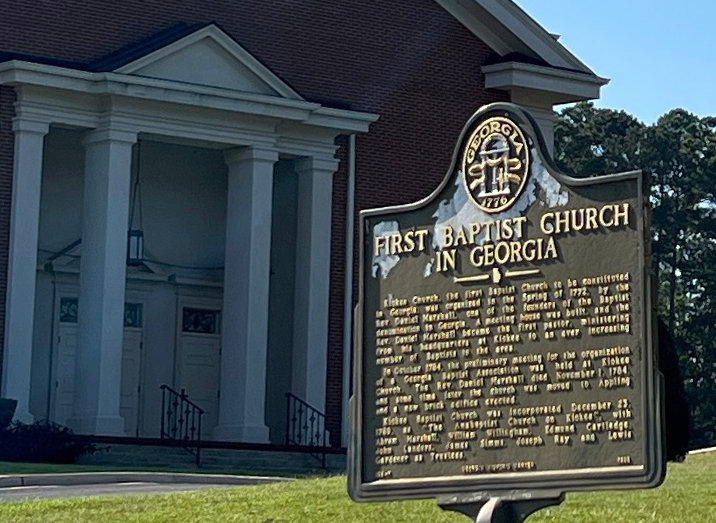
In 1771, a small group of Baptists had gathered for worship by a small creek near the Savannah River. An elderly preacher was on his knees praying when the worship was interrupted by the shout of the arresting officer, “You are my prisoner!” as the heavy hand of the arresting constable hauled the pastor up off his knees.
Confusion, fear, and terror suddenly replaced the sanctity of worship. The pastor, 65-year-old Daniel Marshall, lived across the river in South Carolina and had been invited by the Middlebrook family to preach and baptize one of their family members. After discussion, Middlebrooks agreed to serve as bond, guaranteeing Marshall would show up at the court in Augusta two weeks later. The service was allowed to proceed.
The arresting constable, Samuel Cartledge, and the local magistrate who had accompanied him, Colonel Bernard, remained to watch the service. Two weeks later, Marshall arrived in court to defend himself against the charges of “preaching in the parish of St. Paul without a license.” At the time, Baptists could only preach with a license (permission) granted by the Anglican (state) Church. Parson Ellington of St. Paul’s, who had been an instigator behind the arrest, was in court to accuse Marshall of breaking the law.
This was not the first time Marshall had faced persecution for preaching the gospel. Around 1760, he preached in Virginia, helping to organize the first Separate Baptist Church in that colony. He helped ordain its minister, and according to the accounts of his itinerant preaching tours in Virginia, Marshall “suffered much persecution.”
Nor would it be Marshall’s last brush with persecution. He was detained at least twice during the Revolution by the British and Tories. On one occasion, he was threatened with death. On another occasion, he asked for permission to preach to the British soldiers, which was granted, and he was released afterwards.
The defense Marshall used in the Augusta court was Acts 4:19-20, “Whether it be right in the sight of God to hearken unto you more than unto God, judge ye; for we cannot but speak the things we have seen and heard.” Marshall was admonished and released. One year later, he moved his family to Georgia and established the oldest Baptist church in the state, Kiokee Baptist in 1772.
During the Revolutionary War, Marshall remained in Georgia as other Baptist pastors were forced to flee with their families for safety. This included his son, Abraham Marshall, and Silas Mercer, both of whom served as chaplains with the Georgia militias. The elder Marshall has been credited with keeping those fledgling churches alive during the war when most churches of other denominations failed.
There were other Georgia Baptists who encountered persecution before and during the Revolution. Some had fled persecution in North Carolina following the Battle of Alamance in 1771, which the North Carolina governor, with prejudice, described as “Baptists and Quakers trying to overthrow the Anglican Church.” Both Baptists and Quakers moved to Georgia, the Baptists helping to establish early churches, which numbered seven by the end of the Revolutionary War.
Persecution was a motivation for Baptist support for the Revolution with the hopes of obtaining religious freedom. Following the war, there were other Baptists who had suffered persecution who moved to Georgia. Thomas Maxwell, David Tinsley, and Jeremiah Walker had all been jailed for preaching the gospel in Virginia before the Revolution. They brought with them their experiences, adding to the voices calling for religious liberty in the new state.
The persecution also resulted in changes of heart and soul. Samuel Cartlidge, who arrested Daniel Marshall, was converted and baptized by Marshall, and later ordained. Cartlidge shared the story of Marshall’s arrest and his conversion until he died a few years short of his 100th birthday. The magistrate Colonel Bernard became one of Marshall’s closest friends.
Parson Ellington soon moved on to Savannah’s Christ Church; his replacement was a young parson, James Seymour, from England who was cut from the same cloth as George Whitefield. Seymour was soon writing reports to the Bishop of London that he was traveling a circuit that included holding worship services in the “Kiokee Meeting House.” The persecuted Marshall had a habit of making friends of his enemies and leading them to Jesus.
After the war, Georgia Baptists continued the fight for religious liberty, lobbying the new state government when attempts were made to establish state support for religion and for a school to “train ministers.” Jesse Mercer would compose much of the section of the new Georgia state constitution dealing with issues of church and state.
Jesus said, “Render unto Caesar the things that are Caesar’s and to God the things that are God’s.” For more than 250 years, Georgia Baptists and Baptists across the nation, in what began as a direct response to persecution and oppression, have been working out what it means to render to each what is due. It’s the model of a free church (God’s) in a free state (Caesar’s). Or in the words of Thomas Jefferson, “a wall of separation between church and state.” It has been a hard-fought battle, and it is one which continues; religious liberty and political liberty are friends and allies.
Share with others


