October 2, 2026
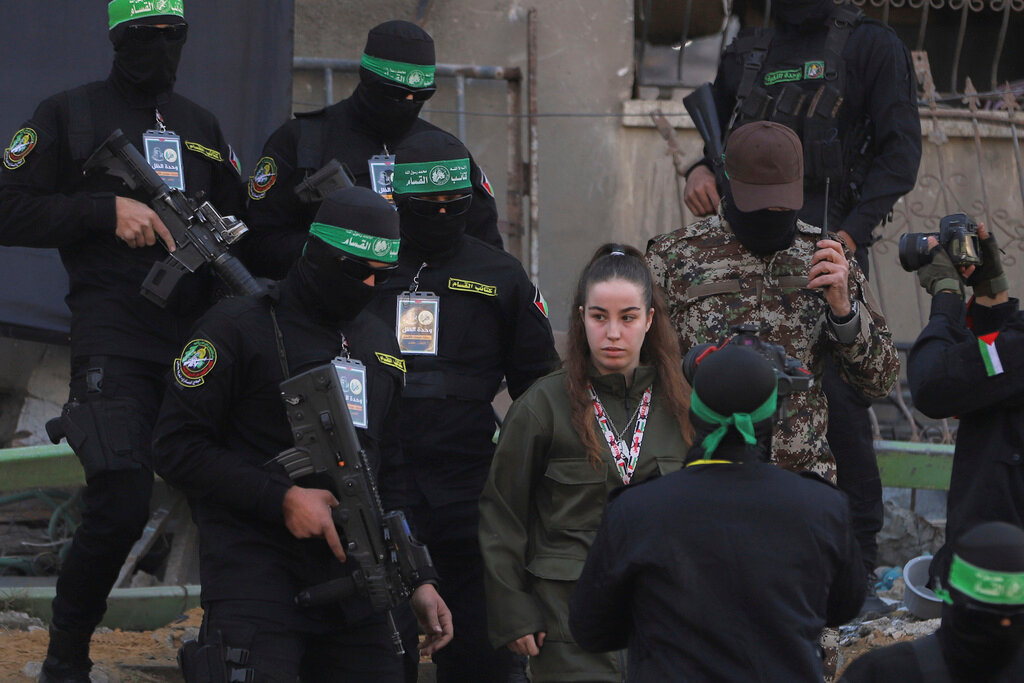
KHAN YOUNIS, Gaza Strip (AP) — Hamas-led terrorists freed eight hostages on Thursday as part of the ceasefire in the Gaza Strip, but the chaotic handover of some of the captives, who were shuttled through a rowdy crowd of thousands by masked militants, drew an angry protest from Israel.
Israel’s plans to release 110 Palestinian prisoners later in the day were put on hold by Prime Minister Benjamin Netanyahu, who demanded that mediators ensure safe exit for hostages going forward. He said later that he had received that commitment, and Israeli media reported the releases would go ahead.
Hamas released seven of the hostages in front of the destroyed home of its slain leader, Yahya Sinwar, as thousands pressed in. The terrorist group called it a “message of determination," but it triggered the latest in a series of disputes that have sent U.S. and Arab mediators scrambling to patch up the truce.
The ceasefire is aimed at eventually ending the deadliest and most destructive war ever fought between Israel and Hamas, and securing the release of dozens of hostages abducted in the group's Oct. 7, 2023, terror attack that ignited the war.
The first hostage — female soldier Agam Berger, 20 — was released after Hamas paraded her in front of a smaller crowd in the heavily destroyed urban Jabaliya refugee camp in northern Gaza.
Hours later, a chaotic scene unfolded at a handover of the other seven in the southern city of Khan Younis. Hundreds of terrorists from Hamas and the smaller Islamic Jihad group arrived with a convoy, and thousands of people gathered to watch, some from the tilted rooftops of bombed-out buildings.
Footage showed hostage Arbel Yehoud, 29, looking stunned as masked militants hustled her through the shouting crowd, pushing people back. Also released were Gadi Moses, an 80-year-old Israeli man, and five Thai laborers, identified by Israel as Watchara Sriaoun, 33; Pongsak Tanna, 36; Sathian Suwankam, 35; Bannawat Seathao, 27; and Surasak Lamnau, 32.
A number of foreign workers were taken along with dozens of Israeli civilians and soldiers during Hamas’ attack. Twenty-three Thais were among more than 100 hostages released during a weeklong ceasefire in November 2023. Israel says three Thais remain in captivity, two of whom are believed to be dead.
Yehoud had been at the center of a dispute earlier this week over the sequence in which the hostages would be released. The United States, Egypt, and Qatar, which brokered the ceasefire after a year of tough negotiations, resolved it with an agreement that Yehoud would be released with the others on Thursday.
About 20 friends of Yehoud gathered in southern Israel watched as the tense scene unfolded on live television. Some cried. Others had their hands over their eyes or mouths. The crowd then burst into tears after she was turned over to the Red Cross.
Netanyahu condemned the “shocking scenes" and called on international mediators to ensure the safety of hostages in future releases.
In the first phase of the ceasefire, Hamas is set to release a total of 33 Israeli hostages, including women, children, older adults and sick or wounded men, in exchange for nearly 2,000 Palestinian prisoners. Israel says Hamas has confirmed that eight of the hostages to be released in this phase are dead.
Israeli forces have meanwhile pulled back from most of Gaza, allowing hundreds of thousands of people to return to what remains of their homes.
The deal calls for Israel and Hamas to negotiate a second phase in which Hamas would release the remaining hostages and the ceasefire would continue indefinitely. The war could resume in early March if an agreement is not reached.
Israel says it is still committed to destroying Hamas, even after the terror group reasserted its rule over Gaza within hours of the truce. A key far-right partner in Netanyahu’s coalition is already calling for the war to resume after the ceasefire’s first phase.
Hamas says it won't release the remaining hostages without an end to the war and a full Israeli withdrawal from Gaza.
Hamas started the war when it sent thousands of terrorists storming into Israel. They killed some 1,200 people, mostly civilians, and abducted around 250.
Israel’s ensuing air and ground war was among the deadliest and most destructive in decades. The Israeli military says it killed over 17,000 fighters, and that it went to great lengths to try to spare civilians. It blames civilian deaths on Hamas because its fighters operate in dense residential neighborhoods and put military infrastructure near homes, schools, and mosques.
Share with others


