October 2, 2026
NIAMEY, Niger (AP) — Niger’s mutinous soldiers said they will prosecute deposed President Mohamed Bazoum for “high treason” and undermining state security, in an announcement hours after the junta said they were open to dialogue with West African nations to resolve the mounting regional crisis.
If found guilty, Bazoum could face the death penalty, according to Niger’s penal code.
Spokesman Col. Maj. Amadou Abdramane said on state television Sunday night that the military regime had “gathered the necessary evidence to prosecute before competent national and international authorities the ousted president and his local and foreign accomplices for high treason and for undermining the internal and external security of Niger.”
The announcement said high-ranking West African politicians and “their international mentors” have made false allegations and attempted to derail a peaceful solution to the crisis in order to justify a military intervention. It said Bazoum was being charged following his exchanges with these people. The statement did not identify specific Western countries and did not specify a date for the trial.
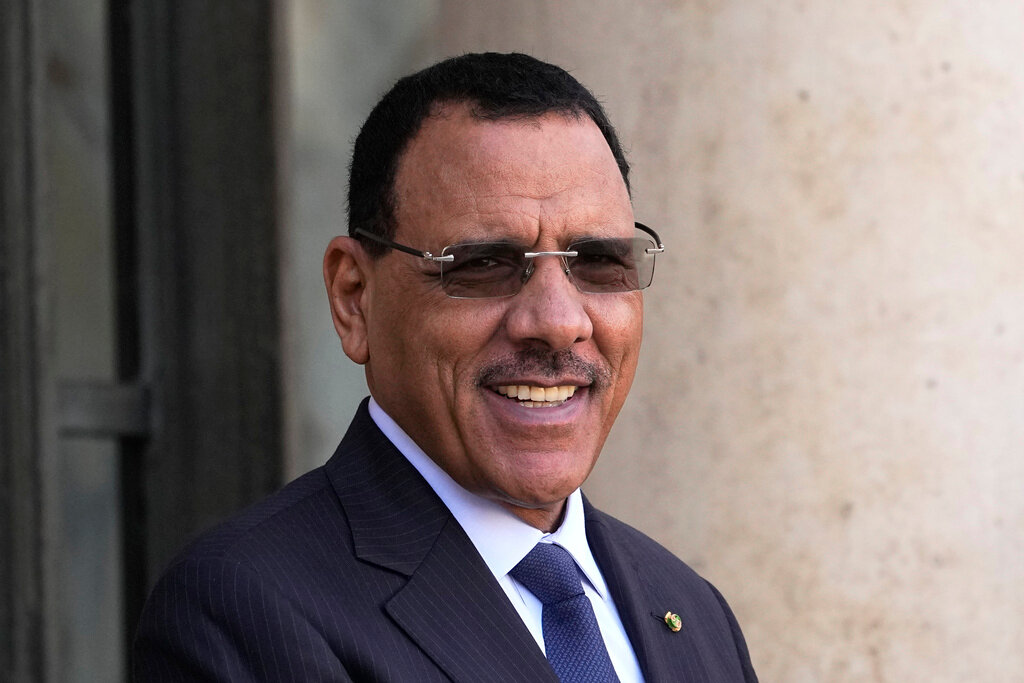
Bazoum, Niger’s democratically elected president, was ousted by members of his presidential guard on July 26 and has since been under house arrest with his wife and son in the presidential compound in the capital, Niamey.
People close to the president as well as those in his ruling party say the family's electricity and water have been cut off and they’re running out of food. The junta dismissed these reports Sunday night and accused West African politicians and international partners of fueling a disinformation campaign to discredit the junta.
International pressure is growing on the junta to release and reinstate Bazoum. Immediately after the coup, the West African regional bloc ECOWAS gave the regime seven days to return him to power and threatened military force if it did not happen, but that deadline came and went with no action from either side.
Last week, ECOWAS ordered the deployment of a “standby” force, but it’s still unclear when or if it would enter the country. The African Union Peace and Security Council is meeting on Monday to discuss Niger's crisis and could overrule the decision if it felt that wider peace and security on the continent was threatened by an intervention.
But as time drags on there's growing uncertainty and mixed messages are mounting.
On Sunday evening, before the military accused Bazoum of treason, a member of the junta’s communication team told journalists that the regime had approved talks with ECOWAS, which would take place in the coming days. That same day, a mediation team of Islamic scholars from neighboring Nigeria who had met with the junta on the weekend, said the regime was open to dialogue with ECOWAS.
Previous attempts by ECOWAS to speak with the junta have foundered, with its delegations being barred from entering the country.
The newfound openness to talks could be a result of ECOWAS pressure, including severe economic and travel sanctions that are already taking a toll on the impoverished country’s some 25 million people, but it doesn’t mean they’ll go anywhere, say Sahel experts.
’Let’s see what these negotiations actually look like, because it’s also in the junta's benefit to at least entertain talks. That doesn’t mean they’ll be serious about them,” said Aneliese Bernard, a former U.S. State Department official who specialized in African affairs and is now director of Strategic Stabilization Advisors, a risk advisory group.
But while talk of dialogue ensues, so does military mobilization.
In a memo from Senegal's security forces dated Aug. 11, seen by The Associated Press, it ordered the “regroupment” from bases in Senegal on Monday as part of its contribution to the ECOWAS mission in Niger. It was unclear what exactly was ordered to move, or where it was going.
In the weeks since the coup, the junta has entrenched itself in power, appointing a new government and leveraging anti-French sentiment against its former colonial ruler to shore up support among the population.
On Sunday, Nigerien security forces were ambushed by fighters believed to be with the Islamic State group who attacked them on a dozen motorcycles, according to a security report for aid groups seen by AP.
This, combined with another attack last week claimed by the al-Qaida-linked group known as JNIM, signifies a new phase of the conflict where groups are trying to consolidate power, and it's largely a consequence of the suspended military operations, said Wassim Nasr, a journalist and senior research fellow at the Soufan Center, told The Associated Press.
“This is due to the halting of cooperation and the military being busy with consolidating their coup in Niamey,” he said. It's also a result of cutting communication and dialogue attempts with some jihadi groups, which had been established under Bazoum, he said.
A former jihadi, Boubacar Moussa, told AP that since the coup he's received multiple phone calls from active jihadis saying they have been celebrating the chaos and greater freedom of movement.
Moussa is part of a nationwide program that encourages jihadi fighters to defect and reintegrate into society, however, it's unclear if that program will continue under the military regime. As the situation evolves, he believes jihadis will take advantage of the security gap and launch new attacks.
Share with others


