October 2, 2026
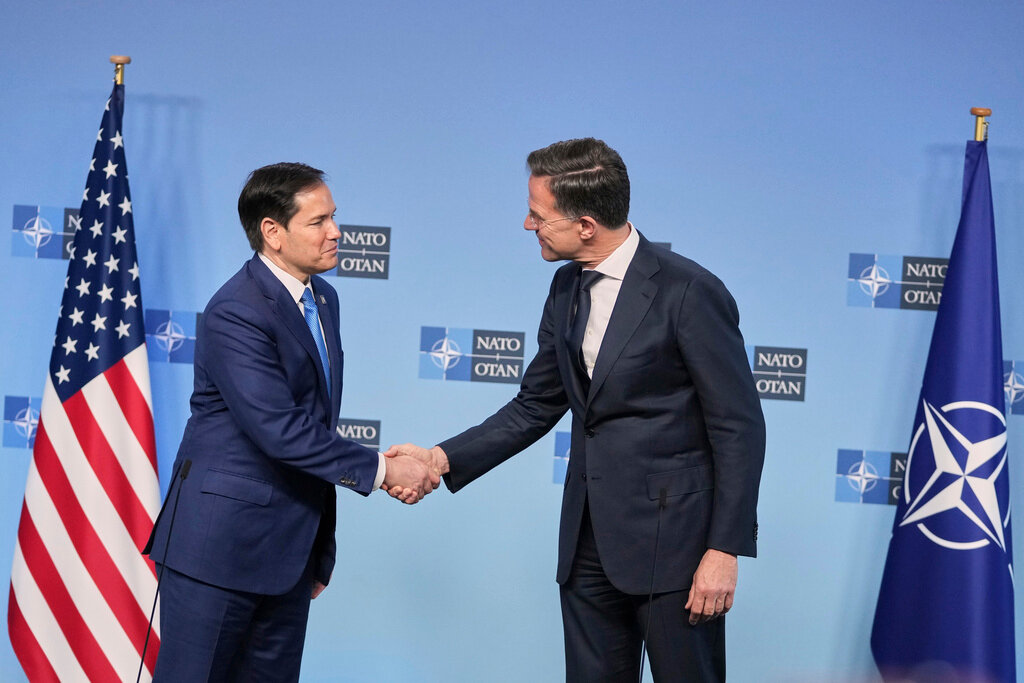
BRUSSELS (AP) — U.S. Secretary of State Marco Rubio and the Trump administration’s new envoy to NATO are seeking to reassure NATO allies of the U.S. commitment to the alliance.
Rubio on Thursday decried “hysteria and hyperbole” in the media about President Donald Trump’s intentions. Rubio and newly confirmed U.S. ambassador to NATO Matt Whitaker are in Brussels for a meeting of alliance foreign ministers at which many are hoping Rubio will shed light on U.S. security plans in Europe.
“The United States is as active in NATO as it has ever been,” Rubio told reporters as he greeted NATO chief Mark Rutte before the meeting began. “And some of this hysteria and hyperbole that I see in the global media and some domestic media in the United States about NATO is unwarranted.”
“President Trump’s made clear he supports NATO,” Rubio said. “We’re going to remain in NATO.”
“We want NATO to be stronger, we want NATO to be more visible, and the only way NATO can get stronger, more visible is if our partners, the nation states that comprise this important alliance, have more capability,” he said.
In a statement, Whitaker said that “under President Trump’s leadership, NATO will be stronger and more effective than ever before, and I believe that a robust NATO can continue to serve as a bedrock of peace and prosperity.” But he added: “NATO’s vitality rests on every ally doing their fair share.”
Asked about concerns among European allies about a possible U.S. troop drawdown and the importance of getting clear messages from the Trump administration, Rutte said: “These issues are not new. There are no plans for them to all of a sudden draw down their presence here in Europe.”
Indeed, the Trump administration has not made its NATO allies aware of any plans it might have. Around 100,000 U.S. troops are stationed in Europe, along with the Navy's 6th Fleet and nuclear warheads. U.S. firepower ensures that NATO’s ability to deter Russia is credible.
“The U.S expects European allies to take more responsibility for their own security,” Dutch Foreign Minister Caspar Veldkamp said, which means that “European NATO countries rapidly have to strengthen the European pillar of NATO and have to increase their defense spending.”
Since Defense Secretary Pete Hegseth warned last month that U.S. security priorities lie elsewhere — in Asia and on the U.S.'s own borders — the Europeans have waited to learn how big a military drawdown in Europe could be and how fast it may happen.
In Europe and Canada, governments are working on “burden shifting” plans to take over more of the load, while trying to ensure that no security vacuum is created if U.S. troops and equipment are withdrawn from the continent.
Share with others


